
.png)
Hidden Gems and Urban Adventures: Unconventional Things to Do in Boston This Spring
2026-02-05

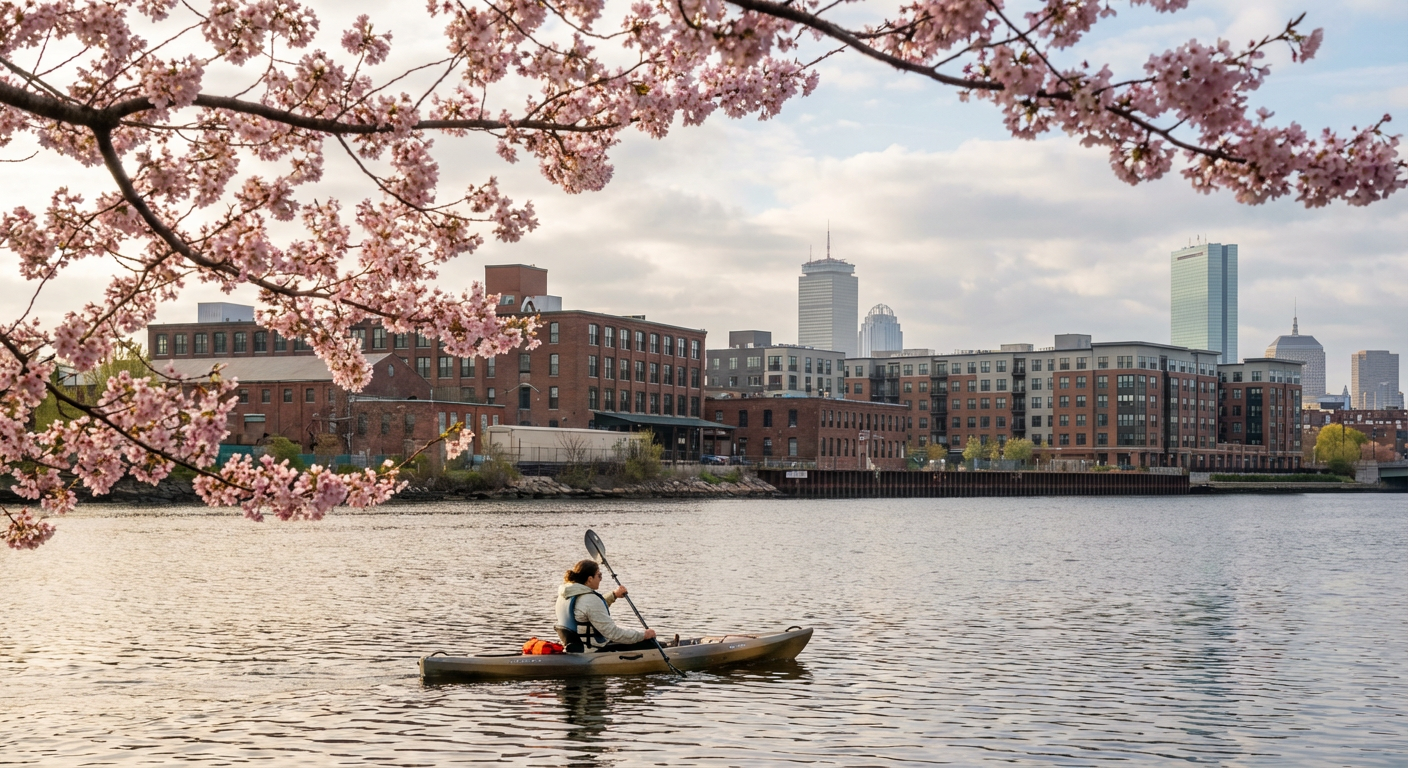
Boston in spring reveals a side of the city that guidebooks often miss. As cherry blossoms frame the brownstones and the Charles River awakens from winter stillness, locals emerge to reclaim their neighborhoods from the winter chill. While tourists flock to [Faneuil Hall](https://www.nps.gov/bost/learn/historyculture/faneuil-hall.htm) and the [Freedom Trail](https://www.thefreedomtrail.org/), there's a parallel Boston waiting to be discovered through its emerging arts districts, waterfront transformations, and vibrant neighborhood scenes. This guide focuses on Boston's lesser-traveled paths and seasonal opportunities that reveal the city's authentic character. Whether you're a resident looking to rediscover your hometown or a visitor seeking experiences beyond the standard itinerary, we've paired each activity with practical rental suggestions from [Yoodlize](https://www.yoodlize.com) to enhance your adventure without the burden of ownership.
Urban Waterways: Boston's Hidden Kayaking Scene
While the [Charles River](https://www.mass.gov/locations/charles-river-reservation) gets all the attention, Boston's network of urban waterways offers surprising paddling opportunities away from the crowds. The [Neponset River Greenway](https://www.mass.gov/locations/neponset-river-greenway), extending from Dorchester to Milton, provides a peaceful alternative with views of marshlands and wildlife that feels miles away from city life. According to the [Boston Harbor Now](https://www.bostonharbornow.org/) organization, spring brings ideal conditions with moderate temperatures and active wildlife before summer crowds arrive. The [Mystic River](https://www.mysticriver.org/) watershed is another overlooked gem, with launch points in Medford and Somerville offering unique perspectives of Boston's northern neighborhoods. The Mystic River Watershed Association maintains several public access points and regularly updates water quality information on their website. What to Rent: A stable, beginner-friendly [kayak](https://www.yoodlize.com/search?qkayak) makes these urban waterways accessible even to novice paddlers. Look for sit-on-top models that provide stability and easy entry/exit. Don't forget a [waterproof bag](https://www.yoodlize.com/search?qwaterproof%20bag) for your phone and valuables, as spring conditions can still bring unexpected splashes. Pro Tips: Check tide charts when paddling near harbor areas, as changing tides can significantly affect current strength Boston's spring weather can shift quickly; bring layers that can be added or removed Many urban launch points have limited parking, so arrive early or use public transit where possible The [Massachusetts Department of Conservation and Recreation (DCR)](https://www.mass.gov/orgs/department-of-conservation-recreation) website lists all official launch points and any temporary closures
Neighborhood Art Walks Beyond the Galleries
Boston's art scene extends far beyond museum walls, with neighborhood-specific installations and street art creating open-air galleries throughout the city. The [Underground at Ink Block](https://www.rosekennedygreenway.org/place/underground-at-ink-block/), tucked beneath Interstate 93, transforms an unlikely space into an 8-acre urban park featuring large-scale murals from local and international artists. This reclaimed space hosts pop-up events throughout spring, with the most vibrant programming starting in April. [East Boston's](https://www.boston.gov/neighborhoods/east-boston) Jeffries Point has emerged as an unexpected canvas for public art, with the [East Boston Artists Group](https://www.eastbostonartists.org/) facilitating new installations each spring. Their self-guided walking tour map (available on their website) highlights both permanent and seasonal works that reflect the neighborhood's maritime history and immigrant influences. What to Rent: Capture these ephemeral art experiences with proper photography equipment. A [mirrorless camera](https://www.yoodlize.com/search?qmirrorless%20camera) with a wide-angle lens works perfectly for architectural and street art contexts, allowing you to capture both detailed textures and broader environmental contexts. Pro Tips: Morning light (before 10am) provides the most flattering illumination for photographing outdoor murals Many installations are weather-dependent; check neighborhood social media pages for pop-up events Some areas have limited signage; download neighborhood art maps before your visit The [Boston Art Commission](https://www.boston.gov/departments/arts-and-culture/public-art) maintains an updated public art map that includes temporary installations
Microbrewery Bike Tours Through Changing Neighborhoods
Boston's craft brewing scene has expanded beyond the familiar [Sam Adams](https://www.samueladams.com/) tour, with microbreweries anchoring neighborhood revitalization throughout the city. The [Dorchester Brewing Company](https://www.dorchesterbrewingcompany.com/) has transformed a former warehouse district into a community gathering space with roof deck views of the Boston skyline rarely seen in tourism photos. A self-guided bicycle tour connecting Dorchester to [Democracy Brewing](https://democracybrewing.com/) in Downtown Crossing and then to [Remnant Brewing](https://remnantbrewing.com/) in Somerville creates a cross-section of Boston neighborhoods rarely experienced in a single day. Each brewery showcases distinctive architectural approaches to adaptive reuse, from industrial spaces to former municipal buildings. What to Rent: A comfortable [city bike](https://www.yoodlize.com/search?qcity%20bike) with a small rack or basket allows for easy navigation between breweries. Electric-assist models make Boston's notorious hills more manageable, especially when traveling between neighborhoods with elevation changes like Somerville and Dorchester. Pro Tips: The [Northern Strand Community Trail](https://www.mass.gov/northern-strand-community-trail) and [Minuteman Bikeway](https://www.mass.gov/locations/minuteman-bikeway) provide car-free connections between several brewing districts Most breweries offer flight options, perfect for sampling without overindulging Many smaller breweries have limited hours; check their social media for current schedules and special releases The [Massachusetts Brewers Guild](https://www.massbrewers.org/) maintains a mobile app with updated information on all breweries in the region
Urban Foraging and Community Gardens
Boston's patchwork of community gardens and edible landscapes offers a surprising opportunity for seasonal foraging and agricultural experiences within city limits. The [Fenway Victory Gardens](https://www.fenwayvictorygardens.org/), America's oldest continuously operating community gardens, come alive in spring with early plantings and communal work days where visitors are often welcomed to participate. The [Boston Food Forest Coalition](https://www.bostonfoodforest.org/) maintains several public food forests throughout the city, including sites in Mattapan and East Boston, where spring brings harvestable greens and edible flowers weeks before conventional produce appears in markets. Their website features a seasonal harvesting guide specific to Boston's growing zones. What to Rent: Proper gardening tools make participation in community garden events more productive. A basic [gardening kit](https://www.yoodlize.com/search?qgardening%20tools) including pruning shears, lightweight gloves, and a folding trowel allows you to join volunteer days or tend to a community plot without investing in equipment you'll rarely use. Pro Tips: Many community gardens host spring seedling exchanges in April and May The [Boston Natural Areas Network](https://www.bostonnatural.org/) provides a calendar of public gardening events where visitors are welcome Foraging should only be done in designated areas with permission; never harvest from conservation areas The [Boston Parks Department](https://www.boston.gov/departments/parks-and-recreation) website lists all community gardens with public access hours
Architectural Photography in Transitional Neighborhoods
Boston's architectural landscape represents layers of history undergoing constant transformation. The [Seaport District](https://www.seaportboston.com/) rapid development provides a fascinating study in contemporary design contrasting with the city's traditional aesthetic. Spring's clear light and longer days create ideal conditions for architectural photography, especially during the "blue hour" just after sunset. Less documented are transitional areas like Allston-Brighton and parts of Dorchester, where industrial buildings are being repurposed while maintaining their structural integrity. The [Boston Preservation Alliance](https://www.bostonpreservation.org/) offers self-guided walking tour maps highlighting these architectural transitions. What to Rent: Architectural photography benefits from specialized equipment. A [tripod](https://www.yoodlize.com/search?qtripod) with a ball head allows for precise framing and stability during longer exposures, while a [polarizing filter](https://www.yoodlize.com/search?qpolarizing%20filter) reduces glare from glass buildings and enhances sky contrast. Pro Tips: Early Sunday mornings offer the emptiest streets for unobstructed architectural shots Boston's historic districts have specific photography guidelines; check neighborhood association websites The [Boston Society of Architects](https://www.architects.org/) hosts seasonal walking tours focused on urban transformation The [Boston Planning and Development Agency](https://www.boston.gov/departments/planning-and-development-agency) website features before/after images of major development zones
Seasonal Itinerary: A Day Exploring Boston's Creative Edge
Morning (8:00 AM - 11:30 AM) Start with an early morning [kayak](https://www.yoodlize.com/search?qkayak) on the Mystic River, launching from the [Blessing of the Bay Boathouse](https://www.somervillema.gov/departments/parks-and-recreation/blessing-bay-boathouse) in Somerville. The morning light illuminates the river's edge where industrial history meets ecological restoration. Return your kayak and head to [Winter Hill Brewing](https://winterhillbrewing.com/) for their weekend breakfast menu. Midday (12:00 PM - 3:30 PM) Rent a [bike](https://www.yoodlize.com/search?qcity%20bike) and follow the community art trail through Somerville to Cambridge, using the [Somerville Community Path](https://www.somervillema.gov/departments/parks-and-recreation/bike-paths). This route connects multiple public installations and studio buildings that open to visitors on weekends. Stop at [Remnant Brewing's](https://remnantbrewing.com/) beer garden for lunch from their rotating food truck schedule. Afternoon (4:00 PM - 7:00 PM) Cross the river to explore the [Underground at Ink Block](https://www.rosekennedygreenway.org/place/underground-at-ink-block/), capturing the dramatic interplay of light and shadow among the massive murals as afternoon transitions to evening. From there, it's a short ride to the [Fort Point Channel](https://www.fortpointarts.org/) area, where former warehouse buildings now house artist cooperatives that host spring open studios. Evening (7:30 PM onward) Complete your day at [Dorchester Brewing Company's](https://www.dorchesterbrewingcompany.com/) rooftop deck, where you can photograph sunset views of the Boston skyline from an angle rarely seen in traditional tourism imagery. Their rotating food partner program showcases different local culinary entrepreneurs each month. This itinerary connects neighborhoods rarely included in conventional Boston tourism while highlighting the city's creative economy and adaptive reuse of industrial spaces.
Boston reveals its most authentic character when you venture beyond the conventional tourism circuit. The city's true identity lives in its neighborhood transitions, creative adaptations of industrial spaces, and the seasonal rhythms of its urban waterways and gardens. By renting equipment through [Yoodlize](https://www.yoodlize.com) rather than purchasing, you gain the flexibility to explore these diverse experiences without accumulating gear that might sit unused between adventures. Whether you're documenting architectural transformations, joining community gardening initiatives, or exploring urban waterways, Boston rewards those who seek its lesser-known stories. As spring unfolds across the city, these experiences offer windows into Boston's evolving identity beyond its historical narrative, revealing a city constantly reinventing itself while honoring its complex past.
.png)