
.png)
How to Make Money Renting Your Gear in Boston, Massachusetts
2026-02-24

Every August, Boston undergoes a transformation that most cities never experience. Tens of thousands of students, researchers, and young professionals flood into the metro area, moving into apartments, setting up home offices, and tackling first-time DIY projects, all within a matter of weeks. Google Trends data confirms it: searches for 'moving to Boston' spike to their annual peak between August 10 and 16, hitting a relative index score of 100, the highest point of the entire year. That surge does not represent tourism. It represents a massive, recurring wave of people who need tools, equipment, and gear they do not yet own and cannot justify buying outright. If you already live in Boston and have a garage, a storage unit, or even a closet full of underused equipment, that annual influx is not just a traffic headache. It is a revenue opportunity. [Yoodlize](https://yoodlize.com) is a peer-to-peer rental marketplace that lets you list items you already own and earn money every time a neighbor, a new arrival, or a local contractor borrows them. This guide explains how the Boston rental market works, what items are in demand right now, and how to start generating income from gear that is currently collecting dust.
Why Boston's Rental Economy Is Structurally Different From Most Cities
Boston is not a typical rental market. The city's housing stock is dense, expensive, and heavily skewed toward renters, which means a significant portion of the population cannot own large tools or equipment even if they wanted to. A renter in a third-floor walkup in Somerville has nowhere to store a chop saw, a pressure washer, or a cargo trailer. They need access to those things without the burden of ownership. At the same time, Boston's real estate market is in the middle of a significant transition. A [December 2025 Boston.com analysis](https://www.boston.com/real-estate/real-estate/2025/12/31/boson-real-estate-market-2026-inventory-rates/) described 2026 as 'the year Massachusetts real estate finally accepts the new normal,' referencing a market where inventory is slowly thawing after years of constrained supply. [New residential projects are breaking ground across Dorchester](https://www.bizjournals.com/boston/news/2025/09/04/work-begins-on-new-dorchester-apartments.html) and Cambridge, with [one developer proposing a 46-acre mixed-use development in Cambridge](https://universalhub.com/2025/developer-proposes-46-acre-project-cambridge-would-include-2076) that includes over 2,000 apartments and millions of square feet of lab and office space. Construction activity at that scale creates sustained, predictable demand for tools and equipment rentals, not just from contractors, but from the homeowners and small landlords doing renovation work on adjacent properties. The structural conditions in Boston, dense housing, high renter concentration, active construction, and a recurring annual influx of new residents, make it one of the most favorable cities in the country for peer-to-peer gear rentals.
What the Trend Data Actually Tells You About Demand
Google Trends data for Boston over the past year reveals a clear and actionable pattern. 'Moving to Boston' search interest sits at a baseline of roughly 25 to 30 index points through the winter and spring, then climbs sharply starting in late July, peaking at 100 in the week of August 10 to 16 before gradually declining through the fall. This is not a random fluctuation. It maps almost perfectly onto the academic calendar, when graduate students, postdocs, and early-career professionals at Boston's universities and research institutions relocate for new positions. Notably, 'remote work Boston' searches also spike during the same August window, reaching 27 to 29 index points, and remain elevated through the fall and into the new year. By late January and early February 2026, 'remote work Boston' was registering 30 to 31 index points, its highest sustained level outside of the August peak. This matters for gear rental hosts because remote workers setting up home offices need equipment: monitors, standing desks, cameras, lighting rigs, and yes, tools for assembling furniture and mounting shelves. The August-to-October window is the single highest-value rental season for Boston hosts, and the data makes that timing unambiguous.
The 12-Inch Chop Saw: A Case Study in Practical Rental Value
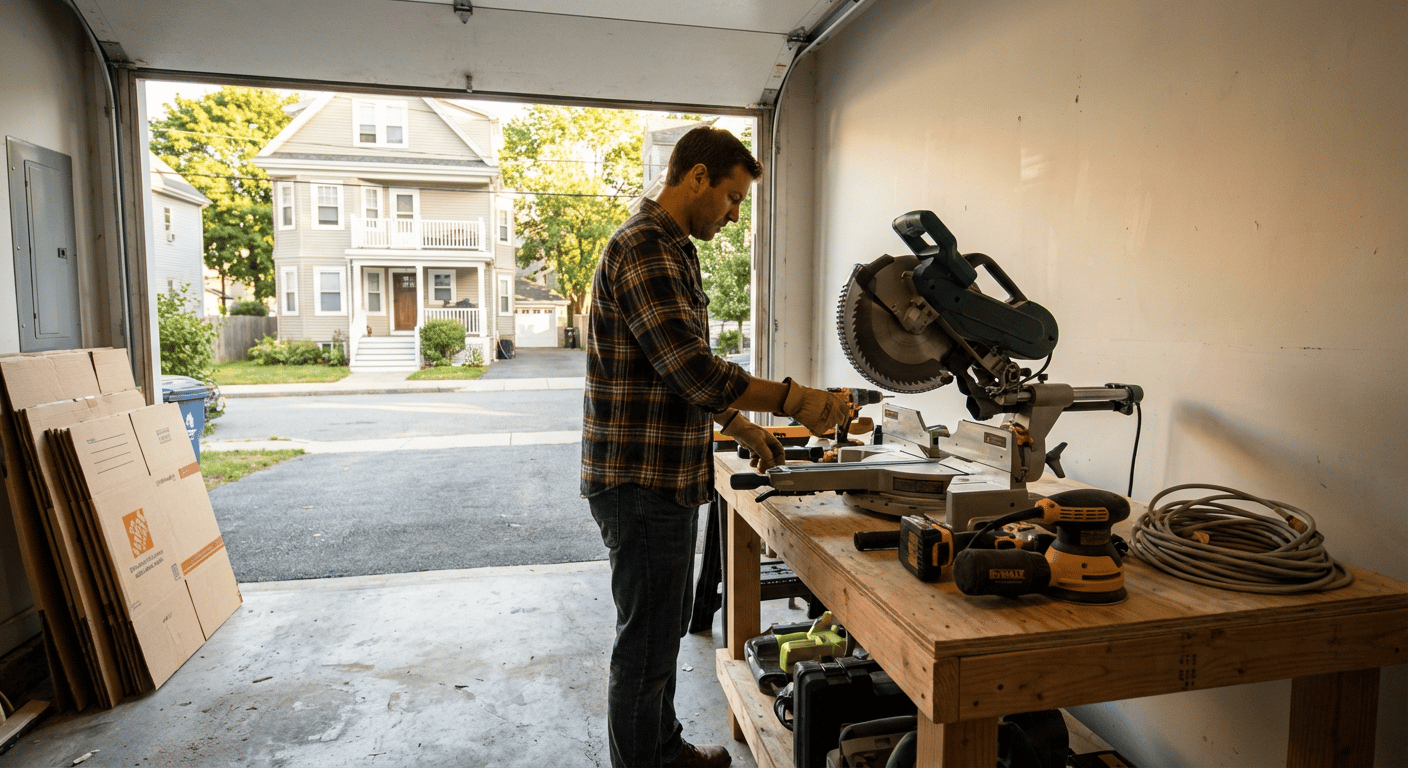
One of the most recent listings added to Yoodlize's Boston marketplace is a [12-inch chop saw](https://app.yoodlize.com/listings/14145/), listed in January 2026 at $20 per day. It is a straightforward listing, a single power tool in good condition, described simply as available 'for all your angle cuts.' But the economics behind it are worth unpacking. A 12-inch chop saw retails for $300 to $600 depending on the brand. Most people who need one for a weekend project, trimming door casings, cutting baseboards, or framing a closet, do not need to own it permanently. At $20 per day, a host needs just 15 to 30 rental days to recoup the full retail cost of the tool, after which every rental is pure profit. In a city where [new apartment construction is accelerating in neighborhoods like Dorchester](https://www.bizjournals.com/boston/news/2025/09/04/work-begins-on-new-dorchester-apartments.html) and where a [Cambridge megaproject is set to add thousands of new residential units](https://universalhub.com/2025/developer-proposes-46-acre-project-cambridge-would-include-2076), the pipeline of people doing one-time renovation and finishing work is not shrinking. It is growing. A chop saw is exactly the kind of high-utility, low-frequency-use tool that makes peer-to-peer rental economically rational for both sides of the transaction. The renter avoids a $400 purchase for a two-day job. The host earns $40 for a weekend they were not using the tool anyway. You can browse this listing and others like it directly on [Yoodlize](https://yoodlize.com).
Seasonal Rental Opportunities Specific to Boston's Calendar
Boston's climate and institutional calendar create four distinct rental demand windows that hosts can plan around. The late summer window, running from late July through September, is driven by the academic move-in cycle and is the highest-volume period for tools, moving equipment, furniture assembly gear, and home office setup items. The fall window, October through November, sees sustained demand from homeowners doing exterior maintenance before winter, including pressure washers, leaf blowers, ladders, and gutter cleaning equipment. The winter and early spring window is quieter for outdoor gear but sees upticks in indoor project tools as people tackle home improvements during the slower months. The spring window, April through June, is when outdoor and recreational gear picks up: bicycles, camping equipment, kayaks, and photography gear for people taking advantage of the warmer weather before the next summer cycle begins. Hosts who maintain a diverse inventory across tool categories can generate income across all four windows rather than relying on a single seasonal spike. The Google Trends data also shows a notable secondary peak in 'moving to Boston' searches during the weeks of late January and early February, likely tied to spring semester arrivals and mid-year job transitions, which creates a smaller but real second opportunity for tools and setup gear rentals.
How to List Your Items on Yoodlize and Start Earning
Getting started on [Yoodlize](https://yoodlize.com) is designed to be straightforward. Create a free account at [yoodlize.com](https://yoodlize.com) and navigate to the listing creation flow. For each item, you will set a daily rental price, write a clear description of the item's condition and any relevant specifications, and upload photos. High-quality photos taken in good lighting are the single most impactful factor in whether a listing gets rented. For tools specifically, photograph the item from multiple angles, include any accessories or blades that come with it, and note the brand and model in the description so renters searching for specific equipment can find your listing. Pricing strategy matters. Research comparable rentals in your area and price competitively for your first few rentals to build reviews and credibility. A $20 per day chop saw is a reasonable market rate in Boston. Once you have a few positive reviews, you can adjust pricing upward. For high-demand periods like August and September, consider setting a minimum rental duration of two to three days to reduce the overhead of frequent handoffs during your busiest window. Yoodlize handles the transaction infrastructure, so you are not managing payments manually. Your primary job as a host is keeping your listings accurate, responding to rental requests promptly, and maintaining your equipment in the condition you advertised.
Maximizing Your Rental Income in Boston's Competitive Market
Boston hosts who treat their Yoodlize listings as a small business rather than a passive afterthought consistently outperform those who list and forget. A few specific strategies make a measurable difference in this market. First, timing your listing updates to align with the August demand surge is critical. Refresh your photos, update your descriptions, and confirm your availability calendar in late July so your listings are visible and current when search volume peaks. Second, bundle complementary items. A host who lists a chop saw, a drill, and a level as a 'renovation starter kit' available for a combined daily rate creates a more compelling offer than three separate listings at the same price. Renters doing a weekend project want to solve their problem in one transaction. Third, leverage Boston's biotech and research community. The city's concentration of life sciences companies and university labs means there is consistent demand for specialized equipment: photography gear for documentation, presentation equipment for conferences, and even audio-visual setups for the kind of professional networking events that organizations like the [Harvard Biotechnology Club](https://x.com/thebiotechclub) host regularly at venues across Cambridge. If you own any professional-grade equipment in these categories, Boston's knowledge economy creates a renter base that most cities simply do not have. Finally, pay attention to the construction pipeline. With [major residential and lab developments underway in Cambridge and Dorchester](https://www.realtor.com/news/trends/cambridge-massachusetts-new-neighborhood-homes/), the demand for contractor-adjacent tools is not a one-season phenomenon. It is a multi-year opportunity for hosts who maintain well-maintained, accurately listed equipment on the platform.
Boston's rental economy has a structural advantage that most cities cannot replicate: a predictable, data-confirmed annual surge of new residents, a dense renter population that cannot store large equipment, and an active construction and research sector that creates sustained demand for specialized gear. The Google Trends data is not ambiguous about when that demand peaks, and the listings already appearing on Yoodlize, like the recently added [12-inch chop saw](https://app.yoodlize.com/listings/14145/) at $20 per day, demonstrate that Boston hosts are already capturing that opportunity. If you have tools, outdoor equipment, home office gear, or any other items sitting unused in your apartment or storage unit, the peer-to-peer rental model turns that idle inventory into a recurring income stream. The August window is the highest-value moment to be listed and active, but the opportunity exists year-round for hosts who understand Boston's seasonal rhythms. Head to [yoodlize.com](https://yoodlize.com), create your free listing today, and position yourself to earn from the next wave of arrivals before they start searching for what you already own.
.png)